2025
-
Self-initiated concept
Joob
A schedule-first job search app that helps students in Canada find work that fits their week, and their network.
Category
Job Search / Product UX
Role
Product Designer

Overview
Joob is a self-initiated concept for a schedule-first job search app for international students in Canada. Over six weeks I ran the project solo, from survey research to a high-fidelity prototype, designing around the constraint that shapes a student's job hunt most: their class schedule.
Instead of generic listings, Joob starts discovery from real availability, then adds school-verified trust and alumni referrals to replace cold applications. I grounded every decision in a survey of 48 students plus my own job hunt, and made a deliberate call about what not to build to keep it fast.
Contribution
Survey research (n=48)
Information architecture
Personas
High-fidelity interactive prototype
Team
Solo
Timeline
6 weeks
Context
Why a job search is hard when you are a student
For international students in Canada, part-time work is often a necessity. But the search has to fit around a fixed class schedule, a thin local network, and little time to figure out where to start. I lived this myself, and kept hitting the same wall.
Problem & Stakes
Bridging student life and work opportunities
Mainstream job boards are built around titles and listings, assuming open availability and an existing network. For a student both assumptions are wrong, so they spend weeks filtering by hand only to find shifts that collide with class.
The stakes are real: a slow search means financial pressure week over week, and for graduating students, missing the narrow window to land a role before their work permit clock runs out. Speed and fit aren't conveniences here. They're the whole point.
Research Insights
What students actually need from a job search
I surveyed 48 international students and cross-checked the findings against my own job hunt. Three needs surfaced again and again.
I mapped three user groups, spanning immediate need to long-term growth.

Mika (20)
The Quick Seeker · current student
Goal:
a part-time job to cover living costs.
Pain:
matching jobs to class gaps is manual and exhausting.

Lucas (24)
The Career Starter · graduating student
Goal:
an entry-level role before his PGWP.
Pain:
silent rejection and no Canadian network.

Sarah (28)
The Supportive Alum · working professional
Goal:
refer and mentor juniors.
Pain:
LinkedIn is too formal; no easy way to vet students.
Strategy & Decision
If schedule is the biggest constraint, discovery should start from availability
I translated each insight into a product principle, keeping every decision traceable to a real need.
Insight (the pain) | Strategic logic (the why) | Feature (the how) |
|---|---|---|
80% struggle for a month or more | Eliminate manual filtering to save time | Availability-Based Matching |
Schedule is the number-one priority | priorityPrevent shift conflicts before they happen | Timetable Sync |
Lack of local connections | Humanize the application process | Verified School Community |

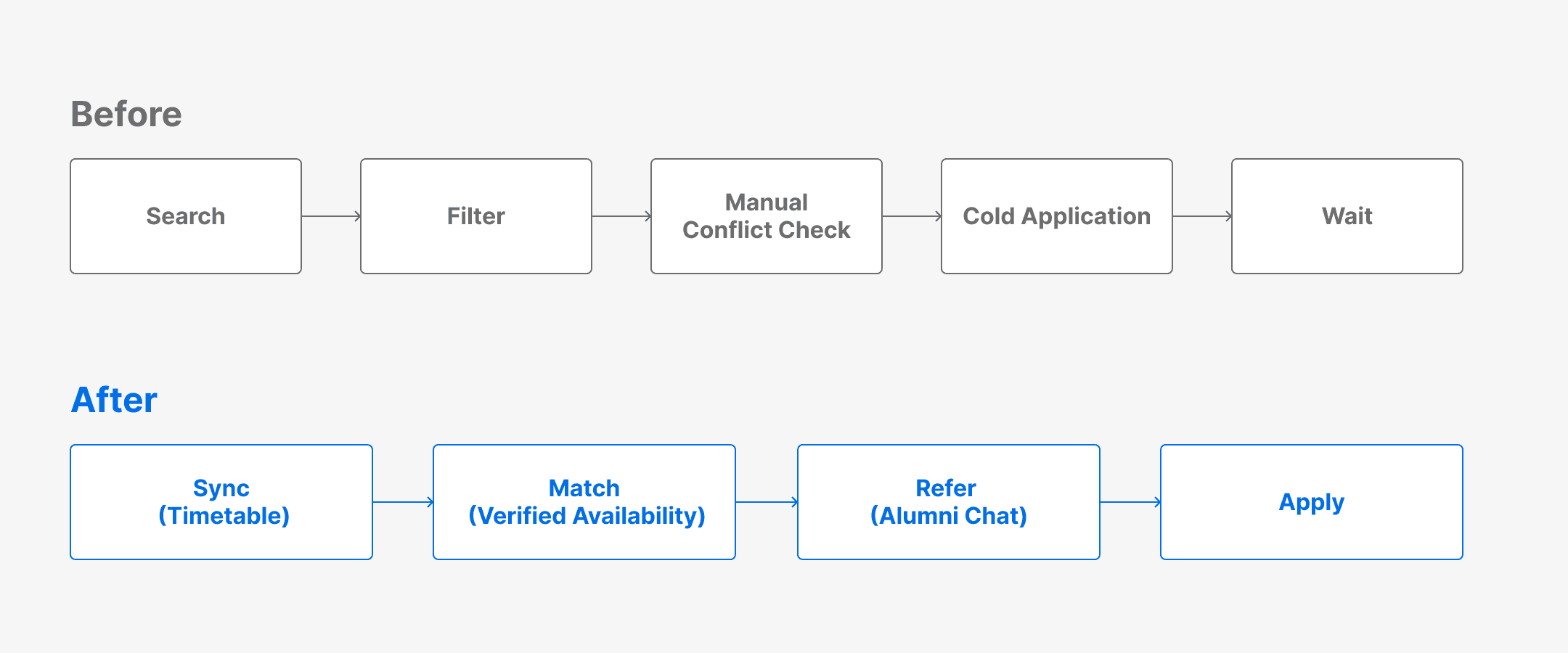
What I chose not to build. Early on I explored an AI career-advisor chat. But research pointed to speed as the dominant pain, and an open-ended conversation added friction. So I cut it, prioritizing instant availability-first matching, and kept the concept focused on the metric that mattered: time to a job that fits.
Design
A simpler path from "I need a job" to "this one fits my week"
I structured the experience around three moves, each tied back to a research insight.
Concept Validation
Testing whether the bet holds up
As a concept, success is whether the core bet holds up, and the research supports it: schedule fit and speed outranked pay and titles, and trusted referrals beat cold applications. The prototype turns that bet into a testable experience.
To take it further, I'd validate in two steps: usability testing on the availability-matching and timetable-sync flows, then a small pilot with one school to measure time to first application, the number that proves whether starting from availability actually works.
Reflection
Designing Around Real Student Constraints
This project helped me think beyond a standard job board experience.
For students, job searching is not only about finding open positions. It is also about balancing time, confidence, local knowledge, and access to trusted connections.
Through Joob, I explored how a job search app could better support students by combining schedule-aware matching, verified communities, and career networking in one experience.


